
About the service
Implantology is a rapidly developing field of dentistry that has revolutionised the way we restore full chewing function to our patients. Losing even a single tooth is not just a cosmetic problem but, above all, a health one. It causes neighbouring teeth to shift, leads to bite problems and to an inevitable process: bone loss.
At Medeor Clinic in Poznań (the Morasko and Naramowice districts) we offer advanced implant treatment. Our aim is to restore your teeth in a way that closely resembles a natural tooth – both in appearance and in how it feels when you eat. A patient who opts for dental implants is investing in their comfort and in the health of their whole mouth.
What are implants and how does a dental implant work?
Many people wonder what implants are. Put simply, a dental implant is a small screw that replaces a lost tooth root. Modern dental implants are made of titanium – a metal that is fully biocompatible. This means the human body does not treat it as a foreign body, which allows the implant and bone to fuse permanently (a process called osseointegration).
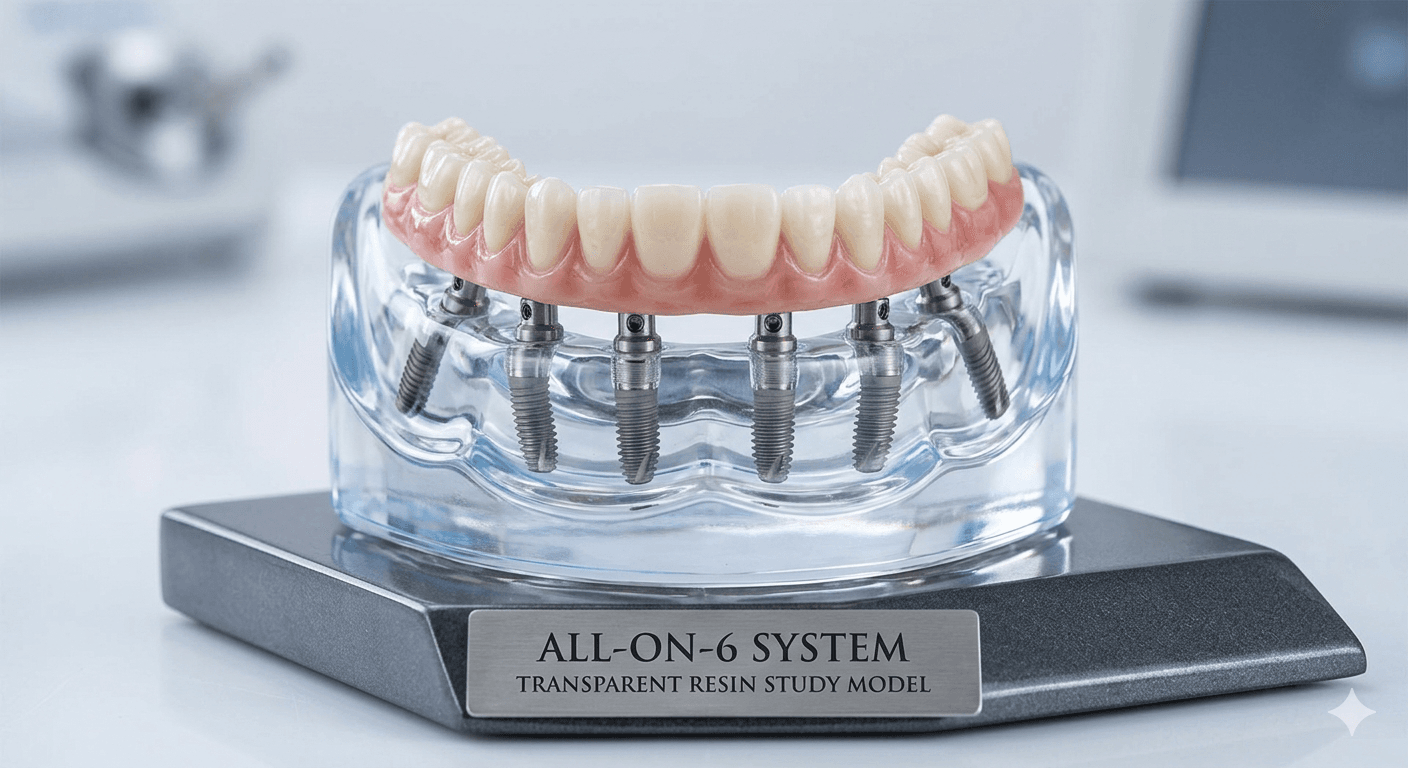
A dental implant provides a solid foundation for a prosthetic restoration. The whole structure usually consists of three parts:
- Implant (the part screwed into the bone).
- Abutment (the part connecting the screw to the crown).
- Prosthetic crown (the visible part of the tooth that the patient bites with).
Thanks to this design, dental implants in Poznań are regarded as the equivalent of a tooth root, providing a stability that traditional removable dentures cannot achieve.
Dental implants in Poznań – the course of treatment
Every implant placement procedure at our clinic is preceded by thorough diagnostics. We base the dental treatment plan on a CT scan (CBCT), which makes it possible to assess the amount and quality of bone in the upper or lower jaw. This is essential so that the implantologist can plan the position of the implant precisely, avoiding sensitive anatomical structures (e.g. the sinuses or nerves).
Stages of treatment:
- Consultation and planning: taking a history, ruling out contraindications (e.g. uncontrolled diabetes, active cancer) and analysing the CT scan.
- Surgery: the doctor makes an incision in the gum and places the implant where the missing tooth was. The procedure is precise and – contrary to what patients fear – minimally invasive.
- Healing: after the procedure comes the osseointegration period, when the titanium fuses with the bone. This usually takes 3 to 6 months. During this time the implant must be left to heal undisturbed. Healing screws are often used to shape the gum for the future crown.
- Prosthetic restoration: once the implant has healed, the patient receives the final solution – a crown, a bridge or a snap-on denture.
Does implant placement hurt?
This is one of the questions we are asked most often. Implant placement is carried out under local anaesthesia, which makes it completely painless for the patient. Modern anaesthetics effectively block the transmission of pain. Once the anaesthetic wears off there may be slight discomfort or swelling, which usually subsides within a few days and is easy to manage with over-the-counter painkillers. Our clinic makes sure that dentistry is associated with a sense of safety, which is why the whole process is monitored by an experienced team.
Restoring your teeth – denture or implant?
Traditional methods of replacing missing teeth, such as bridges, require the healthy neighbouring teeth that serve as abutments to be ground down. Dental implants can be placed without affecting the structure of the remaining teeth, which is their great advantage.
In the case of complete tooth loss, on the other hand, removable dentures often cause problems – they are unstable, can slip out when you speak and make it hard for patients to chew hard food freely. Implant-retained dentures (e.g. overdentures) are a solution for people who want to regain their comfort. Just 2 or 4 implants are enough to hold the denture firmly in place, which restores a beautiful smile and self-confidence.
Implant cost and price list – Dental implants Poznań
The cost of implant treatment depends on many factors, including the type of implant system used, the need for bone reconstruction and the type of crown. Below is an indicative implant price list at Medeor Clinic.
- Open sinus lift – from 2500 PLN. A bone regeneration procedure needed when the floor of the maxillary sinus is too low.
- Closed sinus lift – from 1500 PLN. A less invasive method of bone augmentation.
- Nobel Biocare implant placement (1 site) – 4000 PLN. The price covers the surgical part (placing the screw).
- Removal of an implant placed at another practice – from 1000 PLN. Explantation in the event of complications.
- Bone graft – priced individually. Needed where there is significant bone loss.
- ASC crown on an implant with a custom abutment – 4800 PLN. The final prosthetic restoration (the price depends on the material, e.g. zirconia/porcelain).
- Scan for a surgical guide – 700 PLN. Digital planning of the procedure for greater precision.
- Temporary crown – 150 PLN. An aesthetic solution for the healing period.
- PMMA temporary crown – 600 PLN. A reinforced temporary crown with better aesthetics.
The total price of an implant (surgical + prosthetic part) is always discussed before treatment begins.
How should you care for dental implants?
Many patients think that artificial teeth cannot be affected by tooth decay, so there is no need to look after them. That is a mistake. Although titanium itself does not become diseased, the tissues around the implant (gum and bone) are prone to inflammation (peri-implantitis) caused by bacteria and tartar. For an implant to serve you for years, excellent oral hygiene habits are essential. You should care for your implants just as you would a natural tooth:
- Regular tooth brushing (at least twice a day).
- Using dental floss or a water flosser.
- Regular check-ups and professional cleaning at the practice.
Why choose implant treatment at Medeor Clinic?
Our team consists of experienced doctors for whom implantology and surgery are a passion. We always make sure that replacing missing teeth goes hand in hand with full chewing function. Our dental treatment plan takes into account not only "putting in a new tooth" but also bone health, the condition of the gums and the aesthetics of the whole smile.
We believe that modern diagnostic equipment and precision in planning the procedure translate into safe and long-lasting results. Whether you need a single implant or a comprehensive restoration of a full dental arch – we invite you to a consultation.
If you want to regain comfortable biting and a beautiful smile, don’t wait. Contact us by phone or book an appointment online.