
About the service
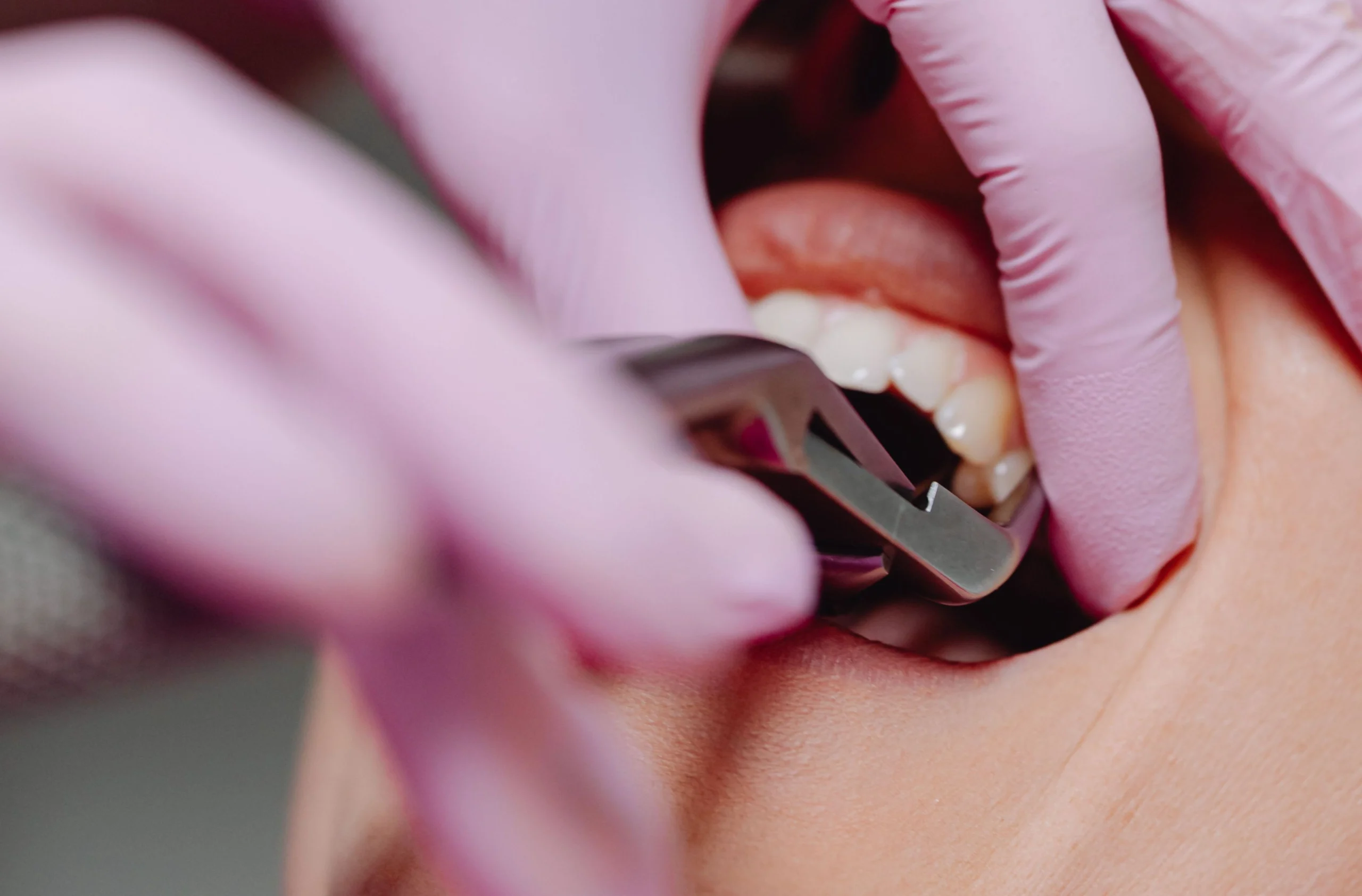
Oral surgery is a broad field of medicine concerned with the surgical treatment of conditions of the mouth and the surrounding areas. Although it is most often associated with procedures such as tooth extraction (removal), modern dentistry offers a much wider range of solutions. At Medeor Clinic in Poznań (in the Morasko and Naramowice districts), surgical procedures aim not only to remove sources of disease but, increasingly, to prepare the patient for prosthetic, implant or orthodontic treatment.
Every patient who comes to our practice is looked after with care that begins with precise diagnosis. Cone beam computed tomography (CBCT) and a panoramic X-ray allow the anatomy of the bone structures (the upper and lower jaw) to be determined accurately and the procedure to be planned in a way that minimises the risk of complications.
Oral surgeon Poznań – when is intervention needed?
An oral surgeon is a specialist to whom patients are referred with more complicated dental problems. The surgeons at our clinic treat inflammation, remove teeth that cannot be saved with conservative methods and also carry out bone and soft tissue regeneration procedures.
Oral surgery in Poznań includes, among other things:
- Extraction of milk teeth and permanent teeth.
- Surgical removal of impacted teeth and retained roots.
- Treatment of periapical lesions (resections).
- Pre-prosthetic surgery and preparation for implants.
- Plastic surgery of soft tissue and bone.
A professional dental practice must offer access to advanced imaging methods. This lets the doctor precisely assess the position of the roots in relation to the nerves or the maxillary sinus, which is crucial for the safety of the procedure.
Surgical tooth removal and treatment methods
Tooth removal (extraction) is a last resort, carried out when conservative dentistry or endodontic treatment does not bring results. This may be due to advanced tooth decay, gum disease (a loose tooth) or mechanical injuries (e.g. vertical root fractures).
Surgical removal differs from a simple extraction in its complexity. It often concerns teeth with an unusual root structure or badly damaged teeth that are not visible in the mouth. In such cases the oral surgeon has to expose the bone and sometimes divide the tooth into smaller pieces (root sectioning) in order to remove it safely from the socket. After the procedure the socket is dressed and, if necessary, stitched, which supports healing. We also use procedures with platelet-rich fibrin (PRF), which speeds up tissue regeneration.
Wisdom tooth removal and extraction of third molars
Wisdom tooth removal is a special category of procedure. The third molars, commonly known as wisdom teeth, often do not have enough room in the dental arch to erupt properly. They may grow at an angle, pressing on neighbouring teeth and causing inflammation and pain.
Wisdom teeth are extracted for orthodontic reasons (crowded teeth) as well as preventively. Impacted teeth are often the problem – teeth that are fully formed but are stuck in the bone and have not broken through the gum. In a procedure such as exposing or removing impacted teeth, the surgeon cuts the gum, removes the piece of bone blocking the tooth and then extracts it. A maxillofacial or oral surgeon assesses how difficult the procedure will be on the basis of an X-ray.
Root-end resection – saving the tooth
Not every tooth with periapical inflammation has to be removed. Conservative dentistry combined with surgery offers a procedure called resection. Root-end resection involves cutting off the end of the tooth root where an inflammatory process is taking place (e.g. a cyst or granuloma) that cannot be cured with conventional root canal treatment. The procedure is performed under magnification, which allows the bone to be cleaned precisely and the canal to be sealed from the root tip. This makes it possible to keep the patient’s own tooth and for it to go on working in the mouth.
Other oral surgery procedures – frenulum and sinuses
Oral surgery is a field that also supports other specialties. As preparation for orthodontic treatment or speech therapy, a frenotomy/frenuloplasty of the lip or tongue frenulum is performed. A frenulum that is too short can cause a diastema (gap between the teeth), gum recession or speech problems.
In implant dentistry, on the other hand, the right amount of bone is crucial. If the bone in the back of the upper jaw has receded, an oral surgeon in Poznań can perform a maxillary sinus floor lift (sinus lift). This procedure involves placing bone substitute material in the sinus space, which then makes it possible to place an implant securely.
Painless tooth removal and patient comfort
Many patients are afraid of pain during procedures. In our practice, comfort and a sense of safety are the priority. All procedures, from simple extractions to complicated removal of impacted teeth, can be carried out under effective local anaesthesia.
The anaesthetics we use completely block the transmission of pain signals in the area being operated on. The patient remains conscious and feels touch and pressure, but the procedure is painless. For patients with severe anxiety (dental phobia), the procedure can be carried out with nitrous oxide (laughing gas), which has a calming and relaxing effect.
Our staff, including our oral surgeon in Poznań, make sure to create a calm atmosphere and explain the procedure in detail. Appropriate medication before and after the procedure minimises the risk of complications and pain once the anaesthetic wears off.
Price list – Oral surgery
Below are approximate prices of oral surgery procedures at Medeor Clinic. The final treatment plan and cost estimate are set by the doctor during the consultation, based on the X-ray/CT images.
- Simple extraction of a permanent tooth – price: 350-700 PLN. Standard removal of a tooth that is visible in the mouth and does not require complicated chiselling.
- Surgical extraction of a permanent tooth – price: 600-900 PLN. A procedure that requires cutting the gum, sectioning the roots or removing bone (chiselling).
- Wisdom tooth extraction – price: 700-1000 PLN. Removal of a wisdom tooth that has erupted properly but needs to be removed for medical reasons.
- Impacted tooth extraction – price: 1000-1500 PLN. Complicated removal of a tooth (most often a wisdom tooth) that remains hidden in the bone.
- Extraction of a developing wisdom tooth bud – price: 900 PLN. Removal of a not yet formed tooth in patients who are still growing (germectomy).
- Root-end resection – price: 1000-1600 PLN. Surgical removal of an inflammatory lesion together with the root tip.
- Biopsy with histopathological examination – price: 600 PLN. Diagnosis of lesions of the oral mucosa.
- Frenotomy/frenuloplasty – price: 500 PLN. A procedure to correct the lip or tongue frenulum, often for orthodontic or speech therapy reasons.
- Removal of stitches placed at another practice – price: 50-100 PLN. A service for patients who had their procedure at another clinic.
- Closure of an oroantral communication – price: 800 PLN. Repair of an opening between the mouth and the sinus that can form after upper molars are removed.