
About the service
An unwanted result after previous contouring does not always mean the whole deposit has to be dissolved straight away. Sometimes it is enough to wait for the swelling to go down, and in other situations a precise correction is needed. Hyaluronidase can dissolve hyaluronic acid injected during a previous treatment and may help, among other things, when lumps, asymmetry or overfilling have appeared.
Before starting, the doctor assesses the treated area, the type of product injected previously and the patient’s health. This matters because hyaluronidase only works on hyaluronic acid and does not dissolve substances made from other materials. The consultation also helps establish whether the correction can be planned or whether the symptoms require urgent help.
What is hyaluronidase and how does it work on hyaluronic acid?
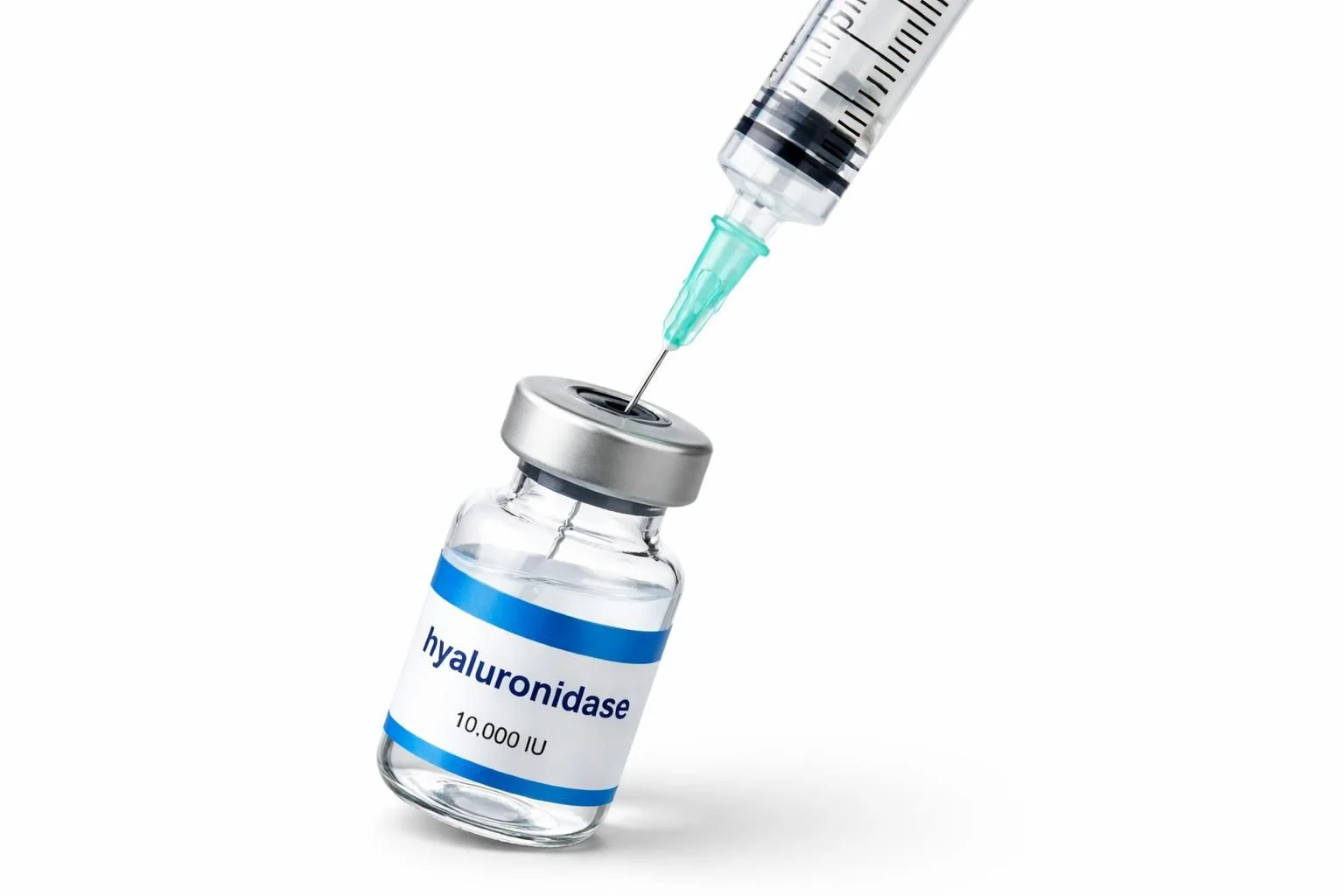
Hyaluronidase is an enzyme that breaks hyaluronic acid molecules down into smaller fragments. This allows the body to remove the acid more quickly from the place where it was injected. Hyaluronidase is widely used in medicine. In aesthetic medicine practice it is used mainly to correct the results of hyaluronic acid treatments and to treat certain complications.
You may come across the claim that hyaluronidase is an enzyme that occurs naturally in the human body. Strictly speaking, the human body produces its own enzymes belonging to this group, whereas the agent used during the procedure is a medicinal product with a specific use. Injected hyaluronidase is an enzyme that causes the breakdown of hyaluronic acid at the injection site.
It is wrong to say that hyaluronidase destroys the skin. However, you should know that the enzyme cannot tell which hyaluronic acid comes from the filler and which is a natural component of the tissues. It may therefore also temporarily break down your own natural hyaluronic acid in the treated area.
Hyaluronidase in aesthetic medicine – indications for treatment
The most common indications for hyaluronidase include:
- too much hyaluronic acid after a previous treatment,
- asymmetry or a result that does not suit the patient’s anatomy and expectations,
- palpable lumps or visible deposits of hyaluronic acid,
- migration of the injected material,
- chronic swelling associated with the presence of filler,
- a vascular complication after hyaluronic acid injection.
Hyaluronidase may be used to correct various areas previously treated with hyaluronic acid. The doctor decides whether to dissolve the whole deposit or only part of it. Not every unevenness is a reason for an injection – in the first days after contouring it may be due to a local tissue reaction or the healing process.
A planned correction or urgent help after filler injection?
Planned hyaluronidase treatment is carried out when the aesthetic result needs correcting but there are no signs of impaired blood supply. The situation is different if, after filler injection, there is severe or increasing pain, blanching of the skin, a mottled or bluish discolouration, coldness of the area or rapidly worsening symptoms. Such symptoms may indicate a vascular complication and require urgent contact with a doctor.
If blood flow is impaired, prompt treatment aims to limit tissue ischaemia. If left untreated, the consequences may include skin necrosis. In such a situation, do not wait for the symptoms to go away on their own or treat advice from the internet as a substitute for a doctor’s direct assessment.
Hyaluronidase treatment – what does the injection involve?
Consultation and assessment of the treated area
Before the procedure, the doctor takes a history and assesses the condition of the skin and tissues. Information about the previous treatment, the name of the filler, when the hyaluronic acid was injected, past allergic reactions and allergy to insect venom is important. The patient should also mention any medicines they take, chronic diseases and current infections.
Hyaluronidase injection
After cleansing the skin, the doctor injects the suitably prepared product into the area that needs correcting. The injection is given with a fine needle into selected points. The dose of hyaluronidase depends, among other things, on the type and amount of hyaluronic acid, its degree of cross-linking, the size of the deposit and the aim of treatment. For this reason, injecting hyaluronidase requires precision and experience – there is no single dose suitable for every person and every area.
The injection itself is usually quick, but the whole appointment also includes a consultation, preparation and observation immediately after the injection. In planned treatment, an allergy test is sometimes carried out, depending on the history and individual risk assessment. A negative result of such a test does not completely rule out an allergic reaction. If ischaemia is suspected, urgent medical treatment is the priority.
Effects of hyaluronidase and dissolving hyaluronic acid
The first effects may be visible quickly, but immediately after the procedure, swelling, redness or unevenness caused by the injection itself make assessment difficult. A fuller assessment of the effect is usually possible a few days after the procedure, when the local reaction begins to subside.
Hyaluronidase can dissolve all or part of a hyaluronic acid-based filler. How much it works depends on the amount and properties of the product, the injection site and the patient’s body’s response. If hyaluronic acid deposits still remain after healing, the doctor may suggest another treatment. It is not always possible to dissolve all the excess hyaluronic acid in a single appointment.
Once healing is complete, you can assess together whether further correction is needed. Any new contouring of the area with hyaluronic acid is planned only once the tissues have settled and in line with the doctor’s advice.
Natural hyaluronic acid and the action of the enzyme
Hyaluronidase does not act selectively on the filler alone. The enzyme may also temporarily break down natural hyaluronic acid in the skin and tissues. For this reason, after the procedure the area may look less full for a while than the patient expected.
The body constantly renews its own components of the extracellular matrix, so the effect on natural hyaluronic acid is not regarded as permanently removing it from the skin. Even so, the procedure should be carried out purposefully and to the extent determined by the doctor’s assessment, without promising perfectly selective dissolution of only the unwanted part of the filler.
Hyaluronidase cream – can it dissolve filler?
The term hyaluronidase cream is sometimes searched for by people who want to reverse the effect of a previous treatment themselves. However, a cream applied to the surface of the skin cannot dissolve cross-linked hyaluronic acid injected deep into the tissues in a controlled way. To correct filler, hyaluronidase is given by a doctor as an injection.
Do not try to inject the enzyme yourself or buy products from unverified sources. Hyaluronidase treatments require knowledge of anatomy, proper assessment and readiness to recognise an allergic reaction or another complication.
Contraindications to treatment and the risk of allergy
The most important circumstances that require particular assessment or postponement of a planned treatment include, among others:
- an active infection or inflammation at the planned injection site,
- known hypersensitivity to hyaluronidase or the ingredients of the product,
- a previous severe allergic reaction after the enzyme was given,
- pregnancy or breastfeeding, in the case of a planned aesthetic correction,
- uncontrolled diseases or treatment that may affect healing and the safety of the procedure.
An allergy to hymenopteran venom is also important, especially bee or wasp venom. People allergic to bee or wasp venom may be at increased risk of a cross-reaction, so anyone allergic to venom must tell the doctor. Patients should not judge for themselves that the allergy alone is an automatic contraindication – the decision is made by the doctor after analysing the type of reaction and the whole history.
The final contraindications to the procedure are determined individually. Different rules apply to a calmly planned correction than to urgent treatment of a suspected vascular complication, in which delay may increase the risk of tissue damage.