
About the service
Over time skin can lose its freshness, elasticity and even tone. In such cases one option is platelet-rich plasma, a preparation obtained from your own blood. The treatment uses some of the blood’s natural components and aims to support the regenerative processes taking place in the tissues.
The therapy is popularly known as a vampire facelift, although it is not a surgical facelift and does not give the same effect as surgically tightening the tissues. At Medeor Clinic in Poznań the treatment is preceded by a consultation, during which the doctor assesses your skin, discusses your expectations and checks for contraindications.
What is platelet-rich plasma (PRP)?
PRP stands for Platelet-Rich Plasma. It is a fraction of plasma with an increased concentration of platelets, prepared immediately before the treatment. The material is autologous, which means it comes from the body of the person being treated.
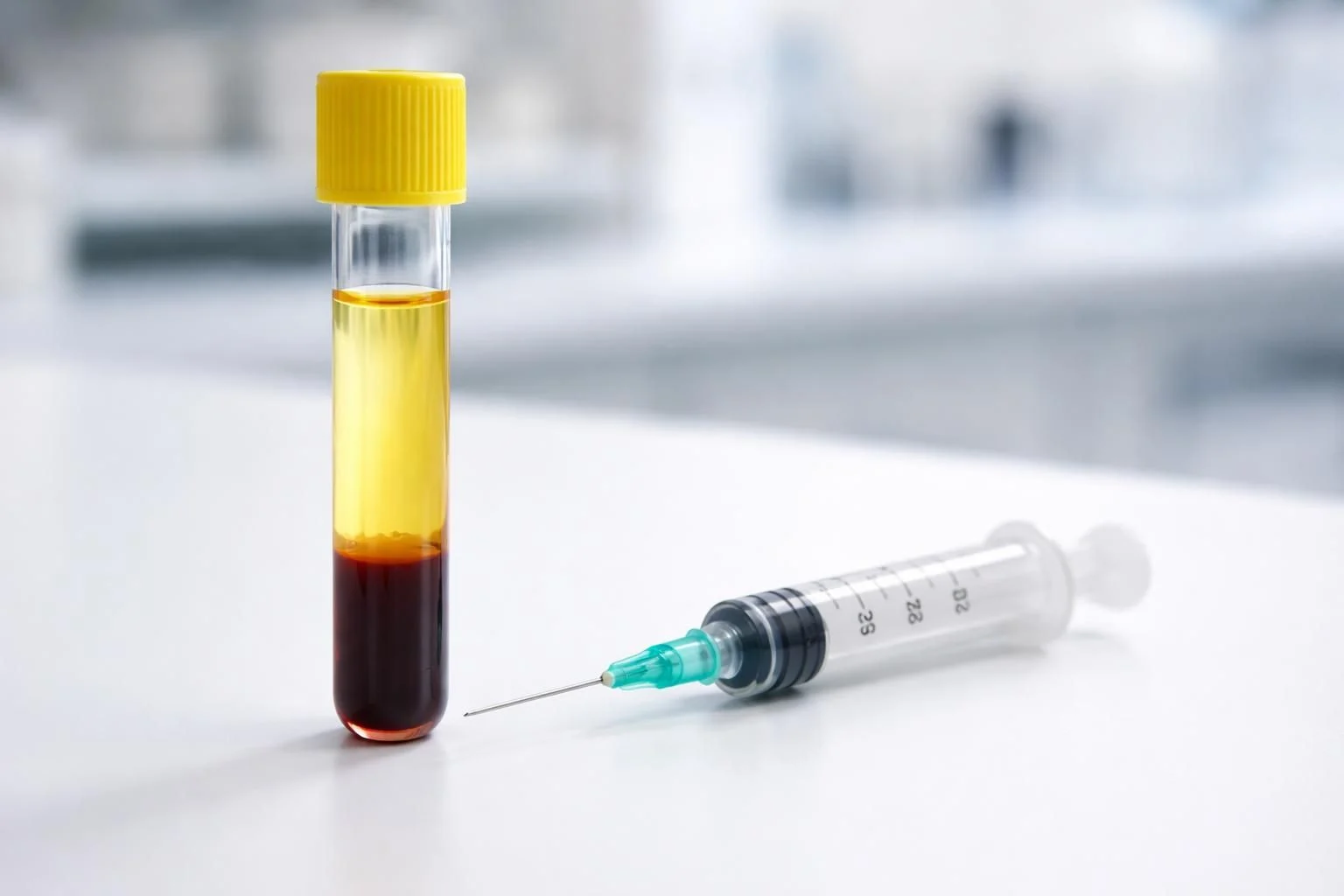
The doctor takes blood from the patient into dedicated tubes. The sample is then centrifuged to separate the different components of the blood. In this way the platelet-rich plasma is separated from the red blood cells and can be used during the treatment.
A platelet-rich plasma preparation is neither a ready-made vitamin cocktail nor a conventional filler. Nor does it contain stem cells, and PRP treatment should not be presented as stem cell therapy. Its action is linked above all to the platelets and the signalling proteins they release.
How do platelet-rich plasma and its growth factors work?
Platelets do more than help blood clot. They also contain growth factors, which play a part in communication between cells and in physiological repair processes. Once the plasma has been properly prepared and injected, these factors can support tissue regeneration and the skin’s local response to the treatment.
Certain growth factors are involved in, among other things, fibroblast activity, collagen production and the formation of new blood vessels. This does not mean, however, that the effect can be predicted precisely for everyone. Skin condition, age, lifestyle, how the PRP is prepared and the body’s individual capacity to regenerate all play a role.
The treatment does not deliver synthetic ingredients designed to fill wrinkles instantly. No active substances are added to the plasma from outside. The plasma is meant to stimulate natural repair processes. Skin renewal is gradual, and the tissue can improve in quality at its own pace.
Uses of platelet-rich plasma in aesthetic medicine
In aesthetic medicine, the uses of platelet-rich plasma include treatments aimed at regenerating the skin and improving its appearance. Depending on the assessment, the treatment can be carried out on the face, neck or décolletage. The area treated is chosen to suit the problem and the change you hope for.
Platelet-rich plasma therapy may be considered when the skin:
- looks tired and has an uneven tone;
- is losing elasticity or firmness;
- is becoming thinner and less springy;
- has fine lines or visible signs of ageing;
- needs support for its repair and renewal processes.
The aim of the therapy may be to improve aspects such as skin density, texture and overall condition. The treatment can help rejuvenate the look of the skin and support its rebuilding, but it does not stop natural ageing. Nor does it replace fillers, botulinum toxin or surgery, as each of these methods meets different needs.
Vampire facelift Poznań – who is this treatment for?
The term vampire facelift refers to a treatment using plasma obtained from your own blood. The name is vivid, but it may suggest a stronger effect than the therapy actually gives. A vampire facelift does not mechanically lift the tissues or change your facial features.
It may suit someone who wants gradual skin regeneration and accepts that the results do not appear immediately. Your own plasma is also sometimes chosen by people looking for a treatment without a conventional filler. This does not mean, however, that the procedure is right for everyone or entirely free of risk.
The assessment is particularly important if the patient has a blood disorder, a clotting disorder or an active infection, or takes medicines that affect platelets. The doctor also assesses whether plasma addresses the problem visible in the area concerned.
What a platelet-rich plasma treatment involves
The treatment begins with a consultation and ruling out contraindications. The doctor asks about illnesses, medicines you take, previous procedures and how your body reacts to having blood taken. They then take a small amount of venous blood and prepare it in a centrifuge. The treatment uses platelet-rich plasma prepared during the same appointment.
Once the required fraction has been separated, the doctor injects the plasma into selected areas with a fine needle. Plasma injections may cause brief stinging, burning or a feeling of pressure. If indicated, an anaesthetic cream may be applied before the injections.
The technique, number of injections and injection depth depend on the area being treated. A platelet-rich plasma treatment ends with individual aftercare advice. The whole procedure covers taking the blood, preparing it and injecting the resulting material.
First results of PRP treatment and skin regeneration
Immediately after the treatment, what you mainly see are injection marks, redness or slight swelling. The first results in terms of improved skin appearance come later. Skin regeneration and tissue remodelling take time.
Over the following weeks the aim of the therapy may be to improve skin tone, elasticity, density and firmness. As collagen is remodelled, the skin may look more rested. The results are individual and do not develop at the same pace in everyone.
The doctor may suggest a single PRP treatment or a series at set intervals. More appointments do not always mean better results. The plan should be based on how your skin responds, the indications and a reassessment of the results.
No one should promise that a single procedure will give spectacular results or an instantly youthful look. Plasma supports biological regenerative processes and tissue regeneration, so the changes are usually gradual and depend on what the body can do.
Platelet-rich plasma and platelet-rich fibrin
Platelet-rich plasma (PRP) and platelet-rich fibrin (PRF) are both made from the patient’s blood, but they are not identical preparations. They differ in how they are prepared, their consistency and how they behave after injection. In PRF the platelets and other components are embedded in a fibrin structure, from which growth factors can be released gradually.
Plasma is more liquid, so it can be given through many superficial injections. Fibrin is thicker and can be used in a different way, depending on the area and the aim of the therapy. The doctor chooses the method after assessing the skin and tissues.
You should not assume that one preparation always gives better results than the other. They are different regenerative therapies, and the choice depends on individual needs.
Contraindications to platelet-rich plasma treatment
Contraindications are assessed individually. The treatment is not performed, among other things, if there is an active infection or inflammation at the planned injection site. Conditions affecting the number or function of platelets, clotting disorders and certain systemic diseases may also matter.
Before your appointment, tell the doctor about all the medicines and supplements you take, especially those that affect blood clotting. Do not stop taking them on your own. Pregnancy and breastfeeding mean a planned aesthetic treatment has to be postponed.
Because the material comes from the treated person’s own blood, the risk of an allergic reaction to the plasma itself is limited. However, an allergic reaction to the disinfectant, anaesthetic or other materials used during the procedure is still possible. The autologous origin of the plasma also does not eliminate the risk of infection, bruising or tissue damage.
Aftercare and recovery
After the treatment the skin may be red, tender and slightly swollen. Bruises and small bumps may appear at the injection sites. Recovery does not usually mean giving up all your daily activities, but visible marks may last for some time.
Until the injection sites have healed, do not touch them with unwashed hands, rub them or massage them unless the doctor specifically tells you to. The skin needs to heal undisturbed. Use gentle skincare and follow the instructions on washing your skin and using cosmetics.
The doctor will tell you when you can return to strenuous exercise, the sauna, swimming pools, sunbathing and other treatments. Aftercare advice may differ depending on the area and how your skin reacts. If you have increasing pain, swelling, a fever, unusual bruising or discharge from an injection site, contact the clinic.
Price list
| Treatment | Price |
|---|---|
| Platelet-rich plasma | 700 PLN |
| Platelet-rich fibrin | 800 PLN |
Specialist
Platelet-rich plasma and fibrin treatments are performed by a doctor after a prior assessment. Medeor Clinic reception can tell you who performs the procedure and which appointments are available.
Platelet-rich plasma Poznań – book a consultation
Would you like to improve the look of your skin, support its regeneration or find out whether a plasma treatment suits your needs? Book a consultation at Medeor Clinic. The doctor will assess your skin and discuss the possible results and limitations of the therapy.
The clinic is at ul. Morasko 24 in Poznań, in the north of the city, near Naramowice. Parking is available on site. To arrange an appointment, call +48 611 611 100.