
About the service
Conscious family planning and choosing the right method of contraception are an important part of caring for every woman’s health and quality of life. Modern gynaecology offers a wide range of options, among which the intrauterine device (often called the coil) holds a special place. It is an exceptionally effective, convenient and fully reversible option. At Medeor Clinic in Poznań, in the north of the city, we give patients access to modern intrauterine methods matched to their individual health needs.
What is an intrauterine device (IUD)?
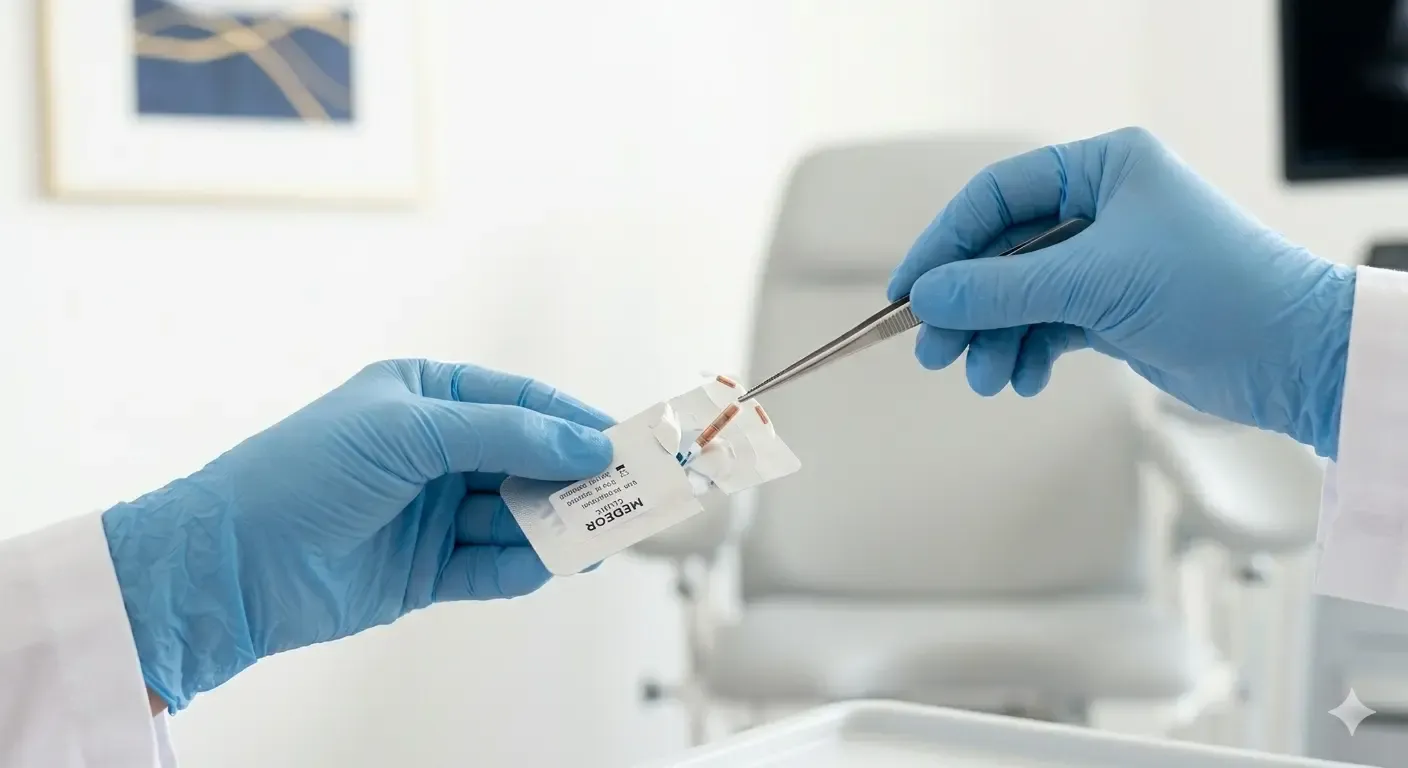
A contraceptive coil (Intrauterine Device – IUD) is a small device made of a material that is safe for the body, usually T-shaped, which a gynaecologist places inside the uterine cavity. It is a long-term method, which means that once fitted, the system protects against unplanned pregnancy for 3 to as many as 10 years, depending on the type of product chosen.
There are two main types of intrauterine systems:
- Hormonal coil (a therapeutic intrauterine system, e.g. Mirena, Kyleena).
- Copper coil (a traditional intrauterine device without hormones).
How intrauterine devices work
Many patients wonder how a small coil can prevent fertilisation so effectively. It works in several ways, depending on whether the system in the uterus is hormonal or non-hormonal.
Hormonal coil – the role of progestogen
Systems such as Mirena and Kyleena steadily release a small amount of a progestogen hormone into the uterine cavity. The hormonal mechanism relies above all on:
- Thickening the mucus: The hormone thickens the mucus of the cervix. Thick cervical mucus becomes a barrier that sperm find hard to get through, which effectively stops them from entering the reproductive tract.
- Effect on the lining: The cyclical build-up of the uterine lining (endometrium) is suppressed, which makes the environment unfriendly to a possible fertilised egg, although fertilisation itself happens extremely rarely.
Copper coil – how copper ions work
Copper coils work mechanically and chemically. The copper they contain (or copper ions) has a strong spermicidal effect. Sperm that come into contact with copper ions lose their ability to move and cannot fertilise the egg. This is an excellent alternative for women who, for health reasons, must avoid hormonal contraception.
Effectiveness and the Pearl Index
It is worth stressing that fitting a contraceptive coil is regarded as one of the most effective methods of preventing pregnancy in the world. Its effectiveness is measured by the Pearl Index, which for intrauterine systems is usually below 1 (meaning fewer than one unplanned pregnancy per 100 women using the method for a year). In this respect the IUD outperforms traditional contraceptive pills, because it rules out the risk of human error, such as a missed pill.
Having a coil fitted at Medeor Clinic
At our medical centre we make sure that the procedure is as stress-free as possible for the patient. It has several stages:
1. Eligibility consultation
Before the coil is fitted, a thorough history and examination are essential. The gynaecologist must rule out any contraindications, which include, among others: suspected pregnancy, acute pelvic inflammation, abnormalities in the structure of the uterus or unexplained bleeding. The assessment usually includes a cervical smear test and an ultrasound scan.
2. Choosing the right coil
During the appointment the doctor talks the patient through the available forms of contraception. If the patient is nulliparous (a woman who has not yet given birth), the specialist may suggest smaller coils, such as Kyleena or the modern IUB system (an intrauterine copper ball), whose shape fits a smaller uterus better.
3. Fitting the system
The actual fitting of a contraceptive coil takes only a few minutes. It is best done during or just after a period, because the cervix is then naturally more open, which makes insertion easier. Using a sterile instrument (an applicator), the doctor inserts the coil through the vagina into the uterine cavity. For patients who are particularly worried about discomfort, a local anaesthetic can be used, which makes for an almost painless coil fitting.
4. Follow-up after the procedure
After insertion the doctor performs a gynaecological ultrasound to check that the system is correctly positioned. A follow-up appointment after the first period following the fitting is also recommended.
Advantages of intrauterine devices
Choosing this method of contraception brings many benefits:
- Convenience: No need to remember a pill every day or to use barrier methods every time you have sex.
- Long-term protection: Protection lasts for years, which makes this method very economical in the long run.
- Reversibility: Once the gynaecologist removes the coil, fertility returns almost immediately.
- Lighter periods: Hormonal systems (e.g. Mirena) often reduce very heavy periods and painful bleeding, which for many women is a key health benefit.
Remember, however, that coils do not protect against sexually transmitted infections.
Specialists and care in Poznań
At Medeor Clinic, long-term contraception procedures are performed by:
- lek. Błażej Kierzkowski – a specialist in obstetrics and gynaecology with extensive experience in diagnosis and in choosing the best methods of preventing pregnancy.
Patients can count on complete discretion, professional counselling and support at every stage – from the first consultation, through the procedure, to follow-up appointments.
Practical information and prices
Below are the costs of having a coil fitted at our clinic. Please remember that every procedure must be preceded by an eligibility consultation with a specialist.
| Specialist | Type of service | Additional information | Price |
|---|---|---|---|
| lek. Błażej Kierzkowski | Fitting a hormonal intrauterine device | Prior consultation required | 1500 PLN |
| lek. Błażej Kierzkowski | Fitting a standard (copper) intrauterine device | Prior consultation required | 1000 PLN |