
About the service
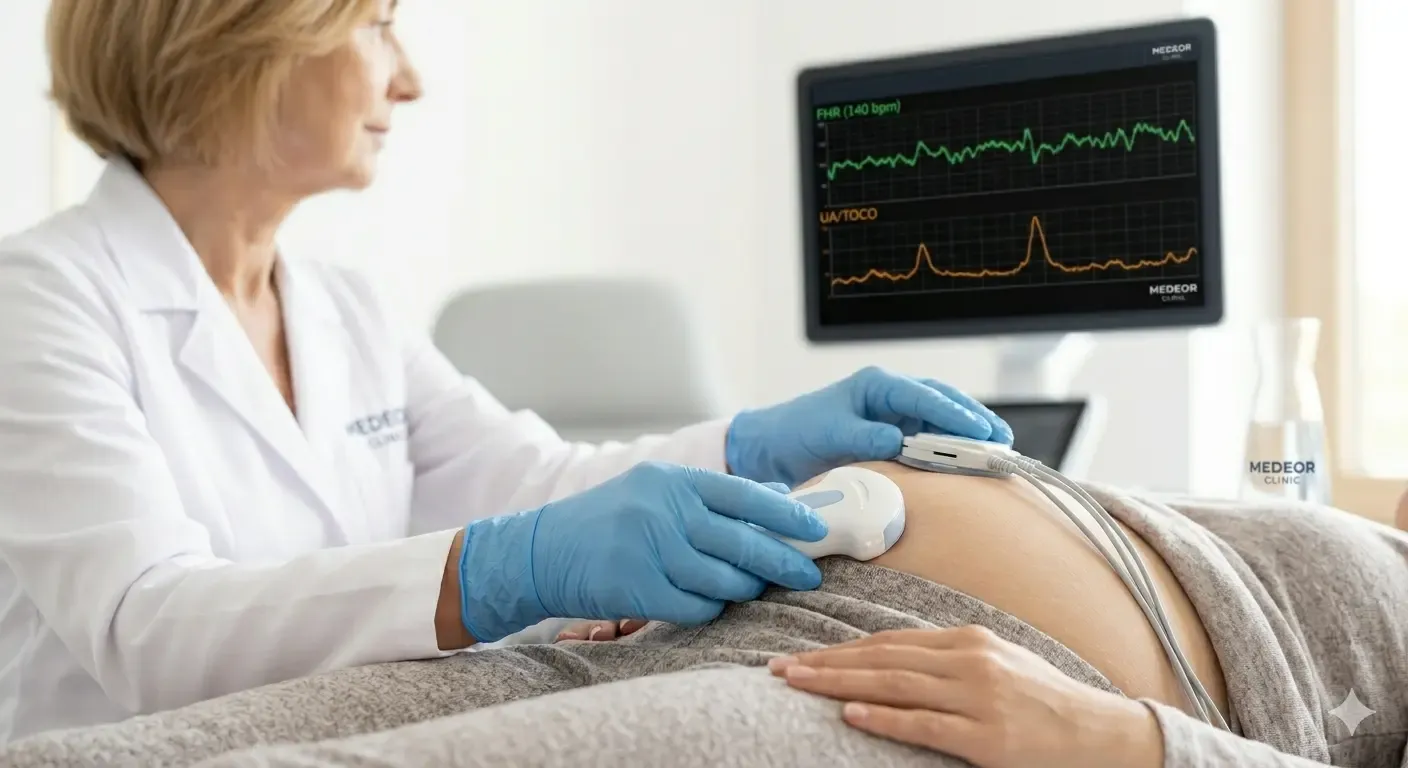
Modern medicine gives future parents tools to monitor their baby’s health even before birth. Prenatal testing is a key part of modern care for pregnant women. Its main aim is to assess fetal development and to detect any abnormalities early, which allows for proper preparation for the birth and for planning medical care after the baby is born. At Medeor Clinic in Poznań, located in the districts of Morasko and Naramowice, we provide access to diagnostics carried out by experienced specialists, in line with current medical standards.
What is prenatal testing and why is it worth having?
Prenatal testing is the term for a group of diagnostic tests carried out during pregnancy. They are divided into non-invasive (screening) and invasive tests. The former are completely safe for mother and baby, as they rely on advanced ultrasound and biochemical blood tests.
These tests allow for:
- Early detection of developmental and genetic abnormalities,
- Assessment of the risk of pregnancy complications (e.g. pre-eclampsia),
- Giving future parents reliable knowledge about the baby’s health, which makes a great difference to their peace of mind while they wait for the birth.
Testing schedule in line with the recommendations of the Polish Society of Gynaecologists and Obstetricians
In line with national standards, prenatal testing in Poznań (as in the rest of the country) should take place at three key points, matching the stages of the baby’s development.
First trimester: examination between weeks 11 and 14 of pregnancy
This screening test is regarded as the most important in prenatal diagnostics. It consists of two parts:
- Ultrasound scan: The doctor assesses the so-called markers of genetic abnormalities, including nuchal translucency (nuchal) and the presence of the nasal bone.
- Biochemical tests: A sample of the mother’s blood is taken to measure the levels of the PAPP-A protein and of free beta hCG.
Combining these data makes it possible to estimate the risk of genetic abnormalities, such as Down syndrome (trisomy 21), Edwards syndrome (trisomy 18) and Patau syndrome (trisomy 13).
Second trimester: the mid-pregnancy scan (weeks 18–22)
In the second trimester of pregnancy, an extremely detailed assessment of fetal anatomy is carried out. This is when the baby’s internal organs are developed enough for a specialist to check their structure carefully. The examination covers, among other things, the heart (ruling out heart defects), the nervous system, the spine, the kidneys and the integrity of the abdominal wall. This is a key stage in detecting developmental abnormalities in the fetus.
Third trimester: examination between weeks 28 and 32 of pregnancy
The third prenatal examination is used above all to assess the baby’s growth and the wellbeing of the intrauterine environment. The doctor checks the amount of amniotic fluid, the position and maturity of the placenta and the blood flow in the vessels (Doppler). This makes it possible to rule out the risk of hypoxia and to assess how ready the mother’s and the baby’s bodies are for the approaching birth.
Modern non-invasive methods (NIPT)
Besides the standard ultrasound protocol and the PAPP-A test, the medical range of diagnostics now includes cell-free fetal DNA tests from the mother’s blood. These tests can be done as early as week 10 of pregnancy. They are highly sensitive in detecting trisomies and other chromosomal abnormalities, such as Turner syndrome. They are particularly recommended for women in a high-risk group whose earlier screening results were inconclusive.
Professional care at Medeor Clinic
Our clinic focuses on reliability and on patients’ peace of mind. Prenatal diagnostics and pregnancy monitoring are carried out by specialists with many years of experience:
- lek. Błażej Kierzkowski
- lek. Jakub Lorek
At Medeor Clinic we use equipment that allows for a precise ultrasound scan, which is essential for a reliable anatomy assessment. We make sure that every patient receives full information about the course of her pregnancy and can count on professional support at every stage.
Specialists and prices of related services
As part of pregnancy care, Medeor Clinic offers regular check-ups that include monitoring of fetal development.
| Specialist | Service | Duration | Price |
|---|---|---|---|
| lek. Błażej Kierzkowski | Pregnancy care + ultrasound (obstetric appointment) | 20 min | 300 PLN |
| lek. Jakub Lorek | Pregnancy care + ultrasound (obstetric appointment) | 15 min | 300 PLN |