
About the service
A joint that suddenly becomes enlarged, accompanied by severe pain, a feeling of tightness and limited mobility, is a signal that should not be ignored. It often indicates an excessive build-up of fluid inside the joint capsule, which patients commonly call “water on the knee” or an effusion. In such situations the key procedure that brings quick relief and allows an accurate diagnosis is joint aspiration.
At Medeor Clinic, our medical centre in a quiet part of the city (Poznań – Morasko, near Naramowice), we provide patients with professional orthopaedic care. Thanks to the convenient location, our specialists are visited not only by residents of Poznań but also by people from nearby towns such as Suchy Las.
What is joint aspiration and what is the purpose of the procedure?
Joint aspiration (arthrocentesis) is a medical procedure in which the joint cavity is punctured with a sterile needle. It serves a dual purpose: diagnostic and therapeutic. Although many people may feel anxious about an appointment involving a needle, in the hands of an experienced doctor it is a safe procedure that brings almost immediate relief.
Therapeutic purpose – decompressing the joint
The main aim of the procedure in the acute phase is to decompress the structures inside the joint. Excess fluid raises the pressure inside the capsule, which irritates the nerve endings and causes severe pain. Draining the fluid (effusion fluid, blood or pus) mechanically reduces this tension, which relieves the symptoms and improves the range of movement.
Diagnostic purpose – fluid analysis
The second, equally important aspect is the opportunity to take a sample for further tests. The joint fluid can be sent for laboratory analysis (biochemical, microbiological or cytological). This lets the doctor establish whether the problem is caused by an injury, rheumatoid inflammation or perhaps a bacterial infection. This knowledge is essential for starting the right treatment and avoiding complications.
When should aspiration be performed? Indications
Whether the procedure is necessary is decided by a specialist during a clinical examination. There are several specific situations in which joint aspiration is the procedure of first choice:
- Sudden swelling of the knee joint: Especially after sports injuries, when bleeding into the joint is suspected (e.g. with damage to the ligaments or menisci).
- Suspected gout: Analysis of the fluid can confirm the presence of urate crystals in the joint.
- Severe inflammation: When the joint is hot, red and very painful, which may suggest an infection.
- Chronic effusions: In degenerative joint diseases, when excess fluid makes everyday activities and rehabilitation difficult.
Many patients look for information about this procedure by reading reviews of clinics in Poznań and comparing standards of care. At Medeor Clinic we focus on good communication and full transparency of procedures – a standard found at the largest orthopaedic centres in Poland, such as Poznań’s Rehasport – while keeping the intimate character of a small clinic.
What happens during the appointment and procedure at Medeor Clinic
Patient safety and sterility are our priorities. What does a typical appointment at our centre look like?
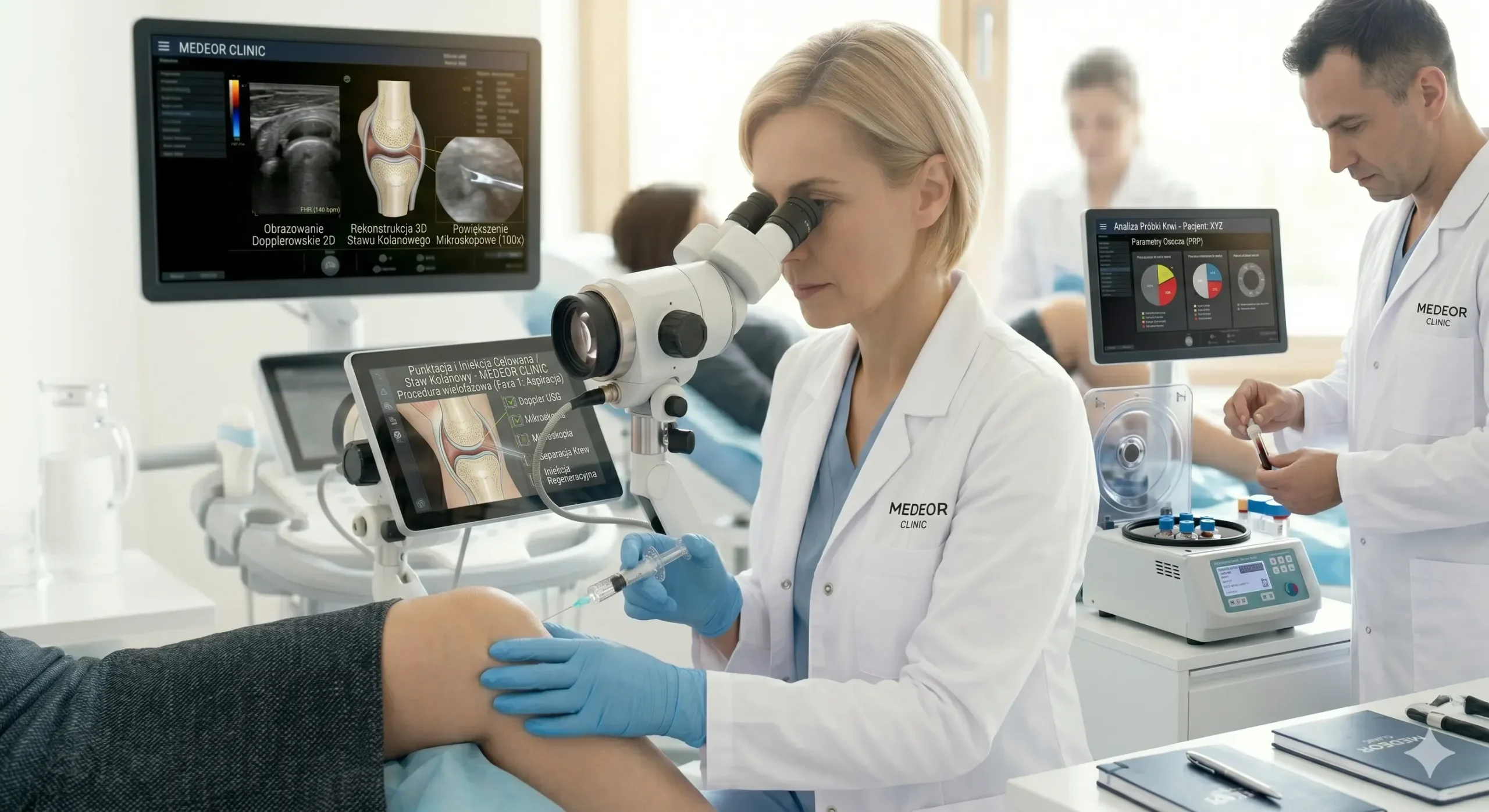
- Consultation and assessment: The orthopaedic doctor takes a history and carries out a physical examination. An ultrasound scan is often used to assess the amount and location of the fluid accurately and to rule out contraindications.
- Preparing the area: The skin over the joint is disinfected several times. The procedure is carried out under sterile conditions.
- Puncturing the joint: The specialist inserts a thin needle into the joint cavity. Thanks to the doctor’s precision and experience, the discomfort is minimal and comparable to having blood taken.
- Drawing off the fluid: The doctor uses a syringe to remove the excess fluid. In some cases, once the joint has been emptied, an anti-inflammatory medicine can be injected directly into it.
- Dressing: After the needle is removed, a sterile dressing is applied and the patient is given aftercare advice.
Contraindications to aspiration
Although the procedure is routine, there are situations in which it cannot be performed. The main contraindications include:
- Skin infections or wounds at the planned puncture site.
- Severe blood clotting disorders.
- The patient not consenting to the procedure.
Every case is considered individually, and the patient’s health and safety always come first.
Specialists and prices – joint aspiration in Poznań
At Medeor Clinic we keep our costs clear. Below you will find information about the doctors who perform the procedure and the current prices of our services.
| Specialist | Service | Price |
|---|---|---|
| Damian Bartkiewicz | Consultation with aspiration | 400 PLN |
| Orthopaedic consultation | 300 PLN | |
| Cyprian Smak | Consultation with aspiration | 400 PLN |
| Orthopaedic consultation | 300 PLN | |
| Marta Krzyszczuk | Orthopaedic consultation | 350 PLN |
If aspiration alone is needed without a full consultation, or during a follow-up appointment, the terms are agreed individually with the doctor in charge of your care.