
About the service
Chronic musculoskeletal pain is a significant diagnostic and therapeutic challenge. When standard oral medication does not bring the expected results, or when inflammation is so severe that it makes exercise impossible, one solution doctors consider is a pain-relief block. It is a precise method of treatment that aims to reach the source of the problem directly, giving patients pain relief and the chance to get back to full fitness.
At our Medeor Clinic medical centre, in the north of the city (Poznań – Naramowice and Morasko), we base the treatment of joint pain on thorough diagnostics and the experience of doctors in traumatology and orthopaedics. Our help is used not only by residents of Poznań but also by patients from nearby places such as Suchy Las, Jelonek, Złotniki looking for expert help with orthopaedic conditions.
What exactly is a pain-relief block?
The term "block" refers to a medical procedure in which a medicinal substance is injected into a specific anatomical site. The most common option is an injection containing a corticosteroid, often combined with a local anaesthetic.
Unlike medicines taken by mouth, a block is given directly into the joint, bursa or tendon sheath, or right next to an irritated nerve. This form of administration achieves a high concentration of the active substance exactly where the disease process is taking place, while limiting the systemic effect of painkillers on the patient’s body.
How does a steroid block work?
The mechanism of this procedure is complex but extremely effective against acute inflammation. A steroid block works by directly inhibiting the synthesis of inflammatory mediators. The steroid, a substance with a very strong anti-inflammatory potential, constricts the blood vessels at the injection site, which reduces swelling and joint effusion.
Using an anaesthetic during the needle insertion gives the patient almost immediate, though temporary, relief. The steroid itself usually starts to work within 2 to 5 days, calming the inflammation for a long time. As a result, a joint block injection not only relieves pain but, above all, breaks the vicious circle of inflammation that damages structures such as ligaments and articular cartilage.
Indications for a block in orthopaedics
The decision to perform the procedure is always made during an appointment with an orthopaedic surgeon in Poznań. The doctor assesses how severe the symptoms are, how long they have lasted and the progress made so far in rehabilitation. There is a wide range of conditions in which pain-relief blocks prove to be a key part of therapy.
Treating peripheral joint pain
Injections are most often used to treat complaints in the large joints. An intra-articular steroid injection is often used for problems with the:
- Knee joint: Degenerative joint changes, synovitis and complaints after sports injuries.
- Shoulder joint: Painful shoulder syndrome, subacromial bursitis and rotator cuff changes.
- Hip joint: Advanced degeneration and inflammation around the greater trochanter of the femur.
Treating spinal pain
Modern traumatology and orthopaedics often use blocks to treat spinal pain syndromes. Spinal pain can result from pressure on nerve roots (sciatica, brachialgia) or from inflammation of the facet joints. Giving the medicine precisely relieves pain caused by inflammation around a compressed nerve, which often allows the patient to avoid or postpone surgery.
Injuries and overuse conditions
The procedure is also used for:
- Epicondylitis (tennis elbow and golfer’s elbow).
- Carpal tunnel syndrome (an injection near the median nerve).
- Plantar fasciitis (the so-called heel spur).
- Pain after fractures and serious injuries, where chronic pain makes it hard to regain full mobility.
Safety and precision: ultrasound-guided injection
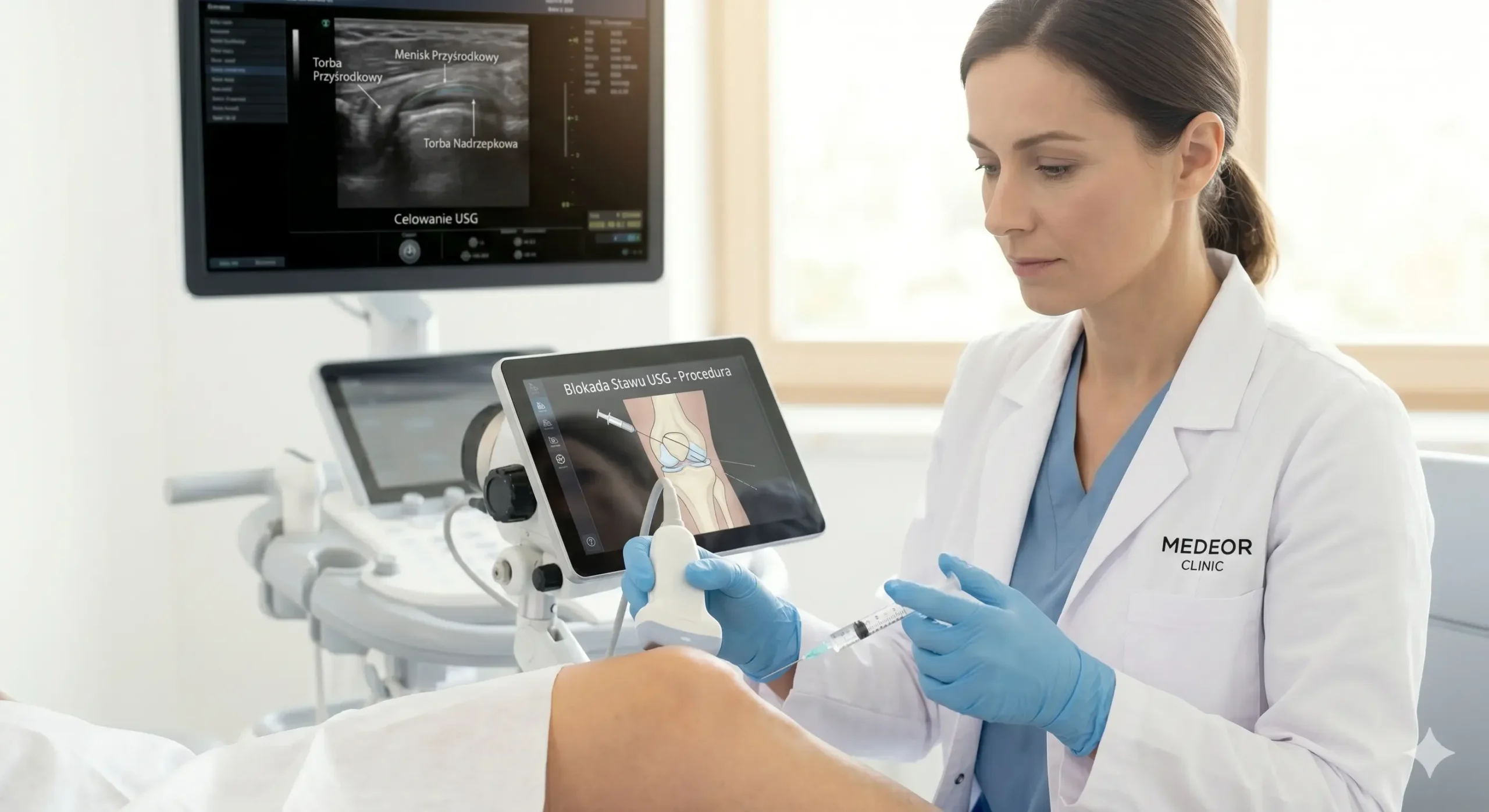
At Medeor Clinic we place particular emphasis on making every injection as precise as possible. Although the doctor’s experience allows many injections to be given using anatomical landmarks, the standard at our medical centre is increasingly to perform blocks under ultrasound guidance.
Why is this so important?
- Guaranteed delivery of the medicine: Real-time imaging lets the doctor make sure that the needle is exactly inside the joint or bursa, or next to the specific nerve.
- Safety of neighbouring structures: Thanks to the imaging, the orthopaedic surgeon can avoid blood vessels and nerve trunks, which helps to minimise the risk of complications.
- Less discomfort: A precise needle insertion reduces the need to move the needle around under the skin, which makes the procedure less painful for the patient.
Every procedure takes place under sterile conditions, using single-use equipment, which ensures the highest level of hygiene and protection against infection.
Your appointment at Medeor Clinic
Patients who come to our clinic for joint pain treatment can count on full diagnostic support. The whole process has several stages:
- Medical assessment: The orthopaedic surgeon takes a detailed history of the nature of the complaint (whether the pain is acute, or chronic and dull). Imaging results and any history of degenerative disease are reviewed.
- Preparing for the procedure: The procedure does not require any special preparation. It is performed under local anaesthesia (often already included in the medicine mixture), which makes it almost painless.
- The injection: After disinfecting the treatment area, the doctor precisely administers the medicine. The whole procedure usually takes from a few to around fifteen minutes.
- Rest after the procedure: The patient stays under observation at the clinic for a short while and can then go home.
It is worth stressing that a block is part of a wider treatment process. Once there is improvement in the form of symptom relief, it is extremely important to continue treatment with specialists such as a physiotherapist. Only a combination of targeted pharmacology and well-chosen physical activity brings long-term pain relief and protects the articular cartilage.
Specialists and prices – pain-relief blocks
Below you will find information about the doctors who perform blocks at our centre and the costs of the individual services.
| Specialist | Service | Price |
|---|---|---|
| Damian Bartkiewicz | Orthopaedic consultation | 300 PLN |
| Consultation with joint aspiration | 400 PLN | |
| Steroid injection (block)* | 150 PLN | |
| Marta Krzyszczuk | Orthopaedic consultation | 350 PLN |
| Steroid injection (block)* | 100 PLN | |
| Cyprian Smak | Orthopaedic consultation | 300 PLN |
| Consultation with joint aspiration | 400 PLN | |
| Steroid injection (block)* | 150 PLN |